Why does capital allocation fail without architecture?
Most organizations do not allocate capital so much as ratify last year's allocation. Budgets renew by inertia, pet projects survive on advocacy, and new bets are sized by whoever argues hardest in the room. The result feels like a decision but behaves like a habit.
When allocation is personality-driven, it is also emotion-driven. Sunk costs keep failing initiatives funded, recency bias chases the last good quarter, and political capital quietly outranks financial logic. None of this is a forecasting problem — it is a structural one. With no architecture deciding how money moves, the loudest signal wins.
What is capital allocation architecture?
Capital allocation architecture is a rule-governed system that decides how investment enters, advances, and exits the portfolio. It replaces discretionary judgment at the moment of decision with pre-agreed gates, so discipline lives in the structure rather than in any individual's willpower.
Decision gates and stage-gating
A decision gate is a checkpoint where capital is released in stages rather than committed all at once. Each stage funds only the evidence needed to justify the next, so a bet that stops paying off stops consuming capital. Stage-gating turns one large, irreversible commitment into a sequence of smaller, reversible ones.
Performance signals and kill criteria
Every gate is governed by signals defined before the money moves: the metrics that prove a thesis is working and the thresholds that prove it is not. Kill criteria are explicit conditions that end funding automatically. Because they are agreed in advance, they remove the emotion from stopping — the gate closes on evidence, not on argument.
How to design capital decision gates
Designing a gate is mostly about deciding the rules before anyone is attached to the outcome. The sequence below builds a gate that can survive its first hard decision.
Pre-commit criteria
Pre-commit criteria are the conditions a proposal must satisfy before any capital is released. They specify the thesis, the evidence that would confirm it, the signals to be tracked, and the kill thresholds — all fixed in advance, while judgment is still neutral.
Define the investment thesis and the single decision the capital serves.
Set the evidence each stage must produce to unlock the next.
Name the signals and kill thresholds before any funding is committed.
Assign the owner who holds the decision right at the gate.
Schedule the cadence at which the gate reopens for review.
Review cadence and reallocation
Gates only create discipline if they reopen on a schedule. A fixed review cadence — quarterly, or tighter for fast-moving bets — forces a fresh comparison of every funded initiative against its signals. Capital that is underperforming is reclaimed and reallocated to what is compounding, so the portfolio drifts toward evidence rather than away from it.
How capital discipline compounds returns
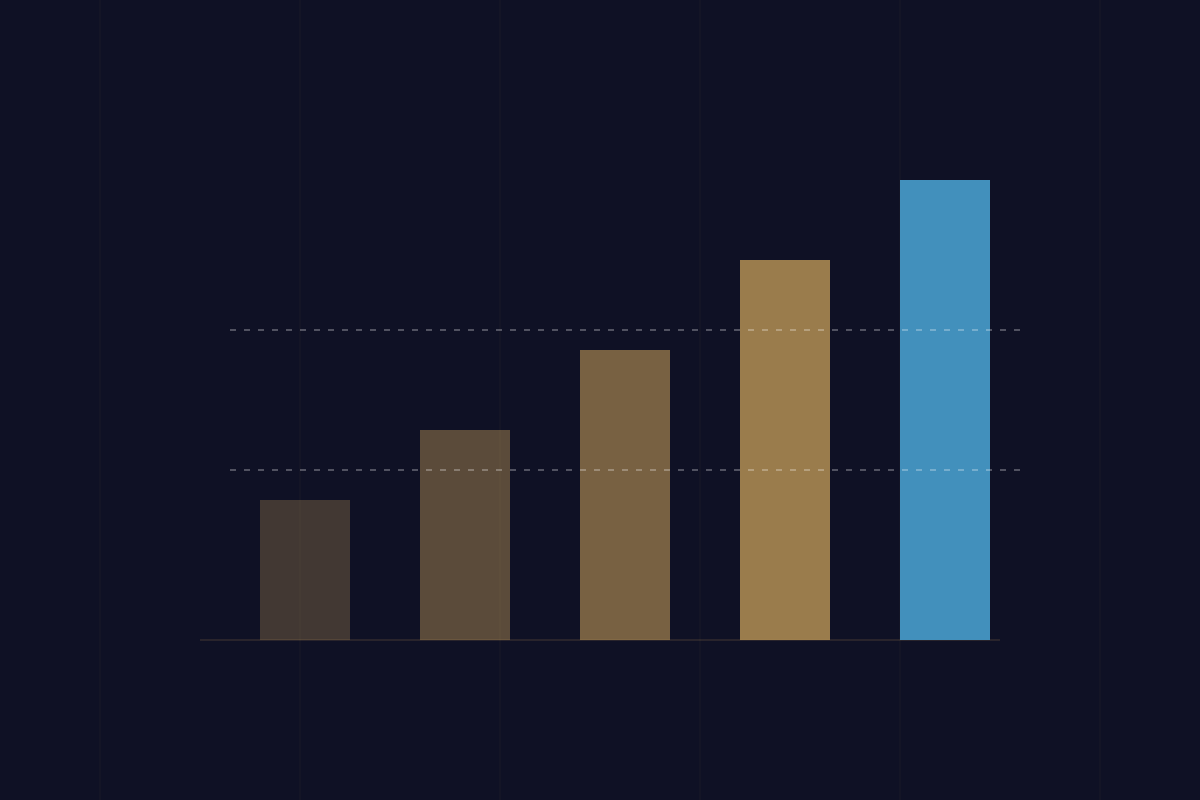
Discipline compounds because each cycle improves the base the next one starts from. When losing bets are killed early, the freed capital is redeployed into winners, and the average quality of the portfolio rises every period. Small, consistent reallocations outperform large, infrequent ones for the same reason interest compounds: the gains are reinvested before they decay.
Over enough cycles, the architecture becomes the advantage. Competitors who allocate by intuition pay for their mistakes at full size and discover them late; an organization governed by gates pays for mistakes in small, early increments and routes the savings into what works. The edge is not a single brilliant bet — it is the structure that keeps capital moving toward returns.